
When Two Search Campaigns Should Be One (and One Should Be Two)
An annotated account map for deciding which campaign boundaries give a business real control—and which merely add another box to manage.


An account can look wonderfully organized while making a decision impossible. It can also look suspiciously simple while giving every offer the control it needs. The campaign count tells you which version of tidiness someone preferred. It does not tell you what the business can decide.
Imagine two Search accounts for air-conditioning companies, each inherited from managers long gone. In one, two campaigns sell the same repair service in the same metro, during the same staffed hours, to the same qualified-call goal. One is called “exact”; the other, “phrase.” In the other account, emergency repair and planned replacement sit together because both are, technically, air conditioning. Each account is a museum of perfectly understandable past decisions. The question is which walls still have a job.
Google defines a campaign as a set of ad groups sharing settings including a budget and location targeting; ad groups can organize related keywords and ads within it. Its campaign guide describes the boundary. So ask a more useful question than Should we consolidate?: What decision would we lose if this campaign line disappeared?
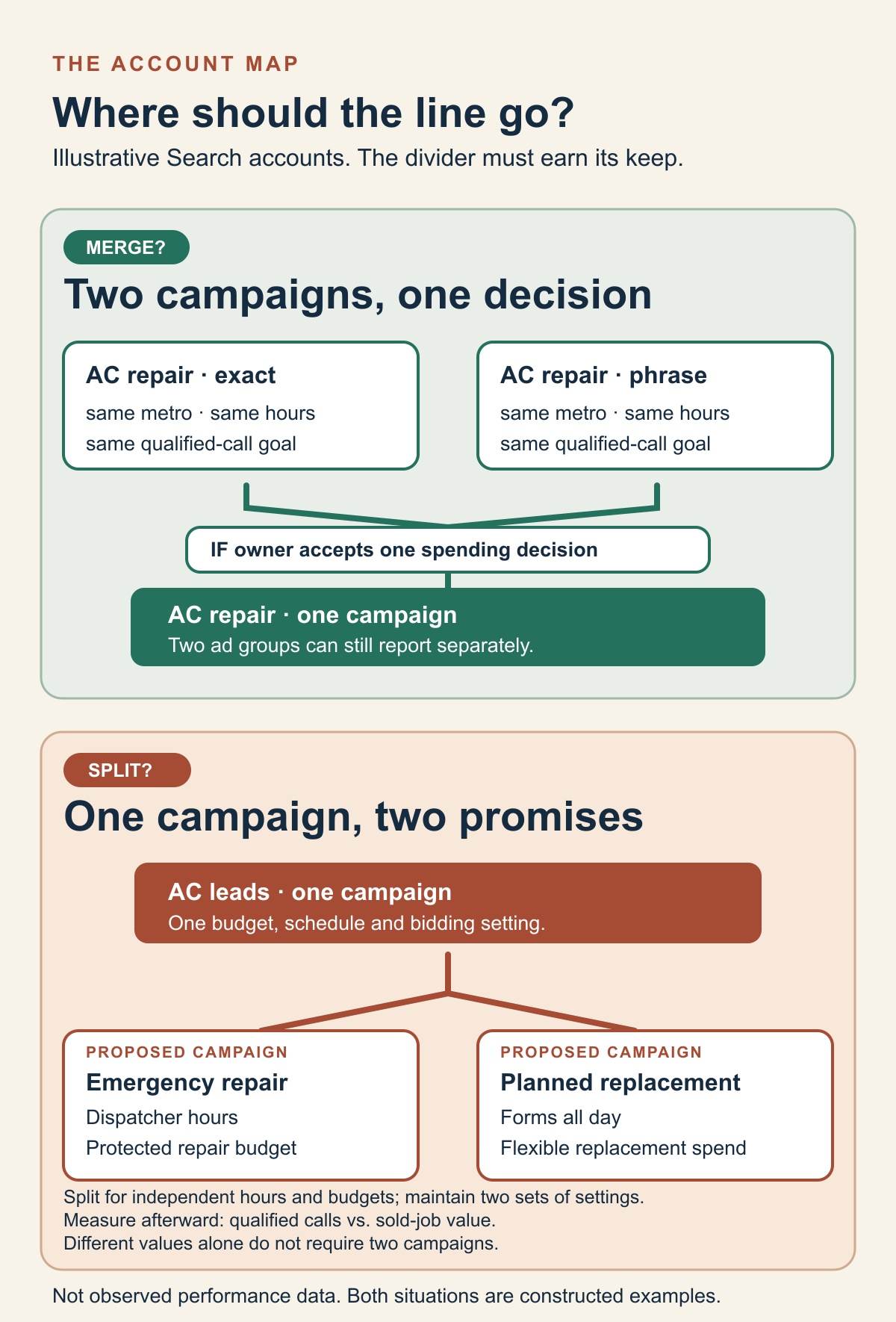
Two invented account situations. The upper join needs the owner’s consent to one spending decision; the lower split buys independent hours and budgets. Different outcome values alone do not draw the line.
A divider with no decision behind it
In the upper half of the map, the “exact” and “phrase” campaigns have different keyword inventories but the same business job. The service area, staffed hours and lead definition are the same. If the owner accepts one spending decision and the operator cannot name an independent budget, schedule, geographic rule or success criterion that one campaign needs, the pair is a plausible merger.
This is not an argument that match types are interchangeable. Keep the keyword and search-term work. Put distinct themes or matching approaches into ad groups where that organization helps ads and landing pages make sense, and continue to read their results separately. Google’s ad-group guidance explicitly supports grouping related ads and keywords inside a campaign. A second campaign buys a second set of campaign settings; a second ad group buys organization without automatically buying that whole settings boundary.
A single box can hide two promises
In the lower half, emergency repair and planned replacement occupy one “AC leads” campaign. Now imagine the actual operating agreement: repair ads should run only while a dispatcher can answer calls, with a distinct budget envelope during heat waves; replacement inquiries can arrive by form all day and should be judged by sold-job value, not simply by call count. The common campaign can give these offers different ads and ad groups. It cannot give each ad group its own campaign budget and ad schedule. Google’s ad-schedule instructions apply schedules to a selected campaign.
That makes the lower branch of the map intelligible: two proposed campaigns, each answerable to its own operating promise. An operator can change repair hours or its budget without changing replacement eligibility or automatically asking replacement to share the same cap. The cost is equally real: another campaign to maintain, another budget to supervise, and more ways for settings to drift. The split earns that cost here because the two services need independent decisions.
What the redraw would give up
For the upper merger, “otherwise our keywords will compete with each other” is a tempting defense of the old line. Google says that when multiple keywords for the same domain are eligible for a search, only one enters the auction. Overlap can still make routing, search-term interpretation and management harder. But “we are bidding against ourselves” is the wrong mechanism for keeping two campaigns.
The repair themes would also draw from one average daily budget and share campaign settings. That is desirable only if the business wants one spending decision. If the owner has promised a protected budget to a particular region or service line, the two similar-looking campaigns may be doing real financial work after all. The upper route is a question for that owner, not a shape to impose on the account.
For the lower split, different lead values alone do not demand different campaigns. Google supports campaign-specific conversion goals, but also describes assigning different values to conversion actions and optimizing for value. The staffed-hours and budget decisions already justify the proposed separation. The remaining measurement question is which actions and values make each campaign accountable to its intended result. A campaign line cannot repair a bad definition of success.
When a city asks for its own line
Try the same question on two city campaigns. If both cities sell the same service, use the same hours and success measure, and one owner is content to let spend follow demand, separate city campaigns may exist chiefly because city rows are pleasant to look at. Location reports can answer the descriptive question. They cannot, by themselves, reserve spend for one city. If a franchise agreement or service capacity requires different geographic eligibility or independent budget decisions, the campaign boundary has a job again. Location targeting is itself a campaign setting.
There is also a middle arrangement that makes “separate or together” less binary. Separate campaigns can use a shared budget, and eligible campaigns can use a portfolio bid strategy. That can preserve distinct campaign settings while pooling spending or bidding decisions. It also means a shared budget does not protect a region’s allocation. If the reason to split was a ring-fenced budget, connecting both campaigns to one pool gives away the very control the split was meant to create.
| If the difference is… | Ask the owner… | Likely structure to investigate |
|---|---|---|
| Keyword set or ad message | Do these offers need different campaign rules, or only different ads and reporting? | One campaign with purposeful ad groups if the rules are shared. |
| Hours, territory or budget authority | Must one side remain eligible, funded or paused independently? | Separate campaigns if that commitment is real. |
| Conversion label | Do the outcomes have different value, or must bidding use truly different goals? | Fix measurement first; separate only when the resulting control requires it. |
| City or service-line visibility | Is the request to see a difference or to act on it? | Use reporting for visibility; create a boundary for independent action. |
Before moving anything, state the decision in the owner’s language: “The two repair match types can share one budget and schedule; emergency repair cannot share replacement’s hours and budget. Is either premise wrong?” An objection to either premise is more useful than approval of a tidy diagram.
Once the premise survives, record current budgets, schedules, locations, bidding and conversion settings; inspect keyword and negative-keyword coverage, ads, landing pages and search-term routing; and define the before/after measure. A structure change is not a clean causal experiment simply because the new diagram looks better. Google’s experiment guidance asks for a clear hypothesis and cautions against changing several things at once if you want to know what caused a result. Keep the account’s history and the business’s decision separate from the performance claim.
The best account map is the one on which every line has an owner who can say what it lets them do. A line with no answer can probably go. A missing line that conceals a real promise needs to be drawn, even if the campaign list becomes a little less photogenic.