
The postcode map was a map of who answered the phone
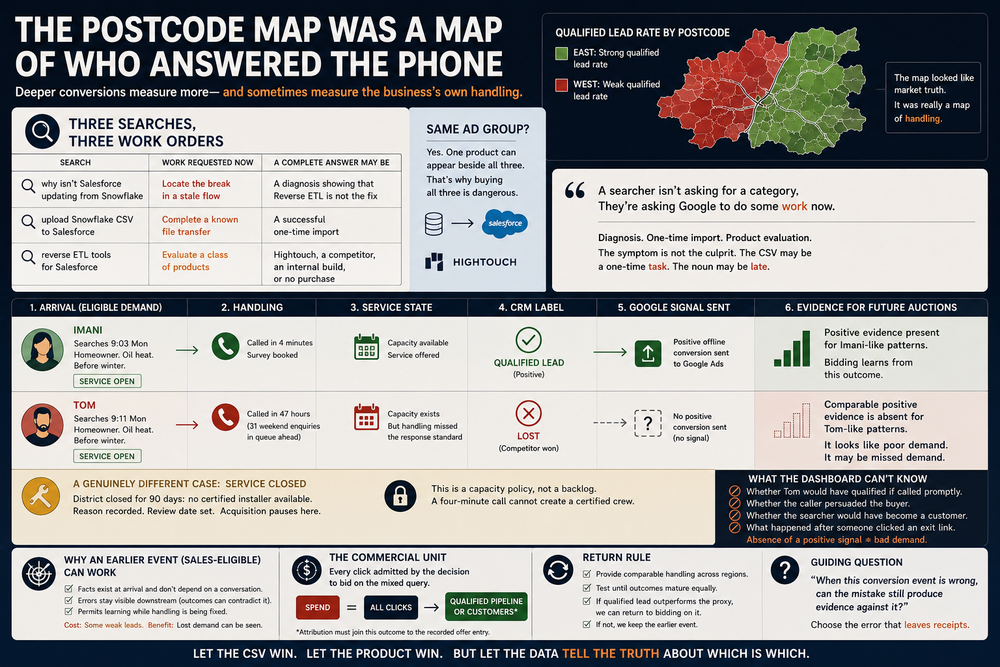
The most persuasive slide in Alder Heat's Tuesday trading meeting was a
postcode map.
Alder Heat is constructed: its people, timings, queue and account events are
invented. The problem they make visible is familiar.
Green covered the east of the heat-pump installer's service area. Red covered
the west. Six weeks earlier, the paid-search team had stopped treating every
enquiry as a primary conversion. It had made the deeper CRM action
Qualified lead the action used for bidding. Now the account appeared to be
getting clever. Eastern postcodes produced qualified homeowners. Western
postcodes produced waste.
The proposed decision was obvious: let Smart Bidding keep leaning east.
Nina, Alder's in-house PPC lead, opened two CRM timelines.
Imani searched air source heat pump installer near me at 9:03 on Monday. Her
form said she owned the house, heated it with oil, and wanted the work completed
before winter. Alder served her postcode. Jess called at 9:07, booked a survey,
and marked the lead Qualified. Alder sent that positive offline conversion
to Google Ads.
Tom made the same search at 9:11. Homeowner. Oil heating. Before winter.
Serviceable postcode. His lead landed with a territory rep who already had 31
weekend enquiries waiting. The first call came 47 hours later. By then Tom had
booked a survey with a competitor. The CRM decision was Lost.
Tom really was a lost sale. But he was not therefore bad demand.
Google did not receive Tom's red Lost label. It received Imani's positive
qualified event and no positive qualified event for Tom. Repeated across a
production process, that difference matters: Smart Bidding uses conversion
outcomes alongside auction-time context such as location, device, time and the
search query. (Google Ads automated
bidding)
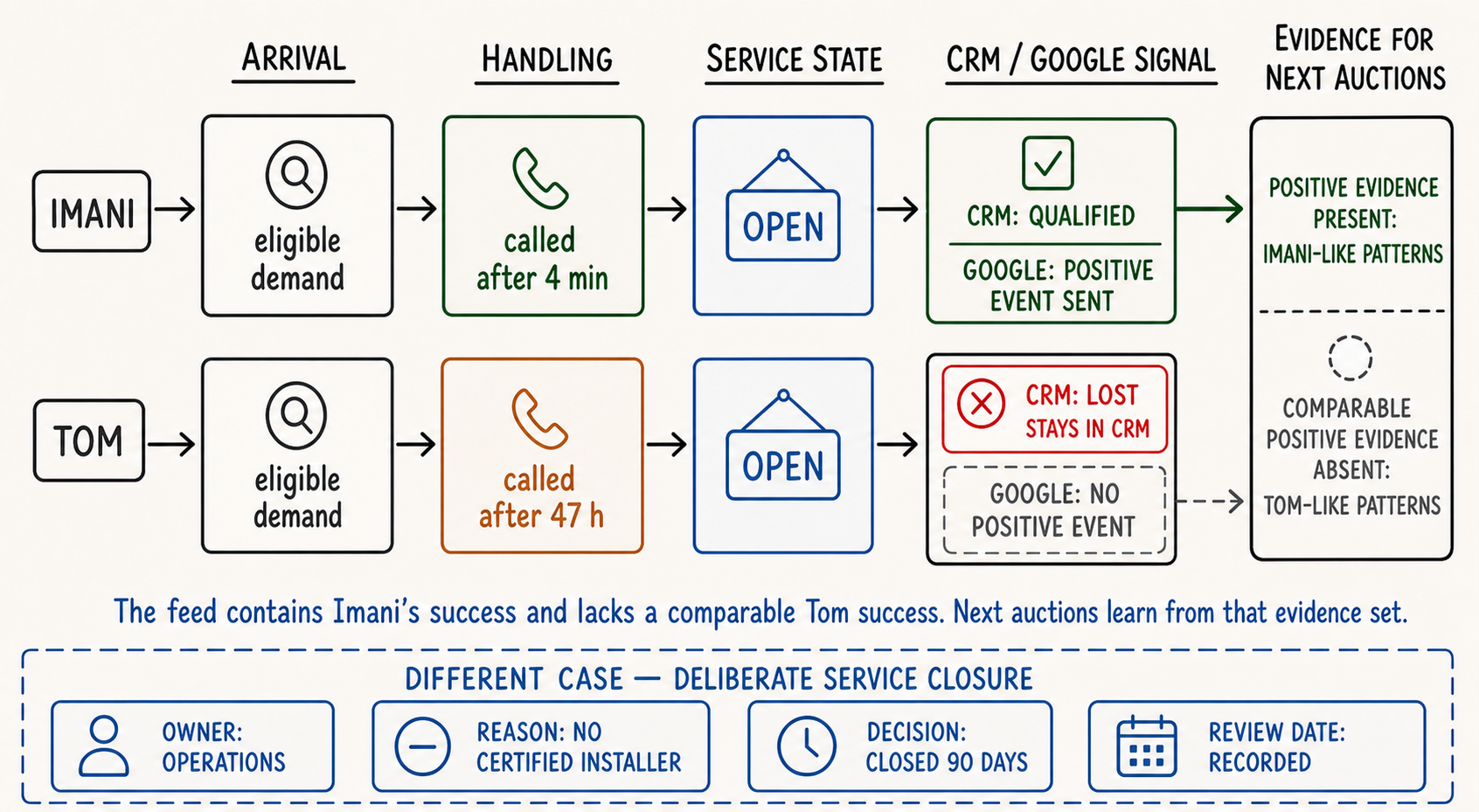
The dashed line is not a secret negative conversion. It is the empty place
where a Tom-shaped success might have been. Later bidding learns from the
evidence set Alder managed to produce.
The call helped write the label—and sometimes changed the outcome
Moving deeper in the funnel is usually a good instinct. A form fill treats a
serious homeowner, a recruiter, a bot and somebody checking whether heat pumps
run on magic as equivalent. Google provides qualified-lead and converted-lead
goal types precisely so advertisers can measure offline stages defined in
their own lead process. (About qualified leads and converted
leads)
But a later event does not merely know more about the customer. It knows more
about what happened to the customer.
A good sales call reveals finance, access, urgency and project fit. It can also
save a wavering sale. A late or clumsy call can make the opportunity disappear.
The conversation is both an instrument of observation and part of the
treatment.
A Qualified label can therefore mix three different things:
- Arrival facts: what was true about the person and project when the form
arrived. - Handling: what Alder did before judging the lead.
- Service state: whether Alder had chosen to serve this work, in this
place, at this time.
The rep-swap test makes the problem visible. Put Tom in Jess's queue at 9:11
and Imani behind the 31 weekend enquiries. Could the CRM labels plausibly swap?
If so, Qualified is partly measuring routing.
It asks one question: did the customer earn the label alone, or did access to
Alder help earn it?
Nina preserved the answer as separate facts. Eligible demand arrived. The
response standard was missed. Service was open. The sale was lost to a
competitor. Sales could own the loss and Operations could own the queue without
Marketing turning either one into a theory about western homeowners.
“You want to feed the queue?”
Nina proposed an earlier conversion event called Sales-eligible lead: a
real, non-duplicate person with usable contact details, asking for a service
Alder sold, with the property, postcode and timescale facts the company needed
at arrival.
The boundary was mechanical. Sales-eligible fired only when the arrival
record met those criteria. If a required fact was missing, the event did not
fire; a later call could not create it. Handling incomplete belonged to the
separate, later decision about qualification, not to this arrival-based
conversion.
The sales director supplied the strongest objection.
“My team is already underwater,” he said. “You want to teach Google that a form
we haven't spoken to is good and send us more of them?”
He was right about the cost. A form cannot reveal impossible access, shaky
finance, an unworkable expectation or the revealing pause after somebody hears
the real price. An earlier event buys some leads that a prompt, capable
conversation would reject. Worse, it can load a broken queue faster. Those are
not tidy statistical blemishes. They are media spend, staff time and possibly
an even slower call to the next Tom.
Keeping Qualified lead has the opposite virtue. When calls are prompt and
competent, it throws away more weak projects before bidding is rewarded. It is
closer to money.
So the choice was not “clean early data” versus “dirty late data.” The earlier
event surrendered commercial discrimination. The later event could hide the
business's hand in producing the discrimination. Nina had to choose an error
Alder could both discover and afford.
One error leaves receipts
The two mistakes leave different records.
When Sales-eligible is wrong, the false positive remains in the cohort. Its
later qualification, survey, sale and installation outcomes can each testify
against the early event. Alder has paid for a weak proxy, but the mistake leaves
receipts.
When Alder bids toward Qualified lead and another Tom is mishandled, the
second mistake leaves no positive qualified event in the feed. That blank looks
exactly like the one left by an enquiry that never deserved to qualify. The
handling cause survives only in Alder's operating record, if Alder kept it
there; it is absent from the qualified-event outcome.
That is the asymmetry: the early error remains available for contradiction; a
handling-caused false negative at the later event can disappear into the same
missing positive as bad demand. Accounting for conversion delay can protect
clicks whose outcomes are merely late; it cannot create an outcome that sales
prevented, never recorded or never uploaded. (How bidding algorithms
learn)
Nina wrote the useful question on the whiteboard:
When this conversion event is wrong, can the mistake still produce evidence
against it?
That was a route of appeal, not a verdict. Later outcomes could prove the early
event wrong; they could not make its waste affordable. An early proxy can spend
too much before its failures reach installation. It can select a large
population with almost no commercial value. It can produce perfectly auditable
bankruptcy. The sales director's objection forced Nina out of the data model
and back into Alder's actual constraint.
Why Alder could carry the earlier error now
The sales director had asked whether Nina wanted to feed the queue. The choice
sat between a territory rep's 31 unanswered weekend enquiries and holes in the
western installation diary.
Alder was not turning ready projects away because crews were full. On the days
eligible leads received prompt calls, some still fell away, but they also
produced surveys and installations. The scarce prize was a viable job, not a
prettier qualification rate.
So Nina did not feed the broken queue. Alder first paid for temporary central
response cover so western overflow could receive the same minimum contact
attempt as the east. Only then could Nina use Sales-eligible without pouring
demand into the queue that had corrupted the deeper event.
Nina's bargain was tangible: Alder would accept media and assessment time spent
on some leads that later proved weak. In return, it would stop letting a missed
call erase a potentially installable job from the signal while it repaired
handling. The new cover could absorb extra assessment work; an empty
installation day could not be recovered.
This is why Sales-eligible was tolerable for Alder now, not why it is a
universally safer conversion. If prompt-handled eligible leads had crowded out
better work, exhausted survey capacity or almost never reached installation,
their visible errors would still have been commercially unacceptable.
Nina made Sales-eligible the action this campaign used for bidding and kept
Qualified, survey, sale and installation measured as observations rather
than competing bidding instructions. (About conversion
goals) The deeper events
became checks against the earlier proxy.
The separate qualification boundary still mattered. If deciding
Qualified versus Unqualified required a conversation, a lead could not
be rejected for failing a conversation it never received. Until Alder made the
minimum contact attempt, the record was Handling incomplete, not
Unqualified.
There was no third state in which silence from Alder became knowledge about
the homeowner.
A backlog is not a closed door
There was one case where current capacity should change acquisition.
Suppose Alder lost the only installer certified for Tom's district. Operations
could decide not to accept new work there for 90 days, record the certification
gap as the reason, own the closure and set the review date. A four-minute call
would not make a certified crew appear. Tom might remain excellent market
demand while being worth little to Alder right now.
That constraint belonged in acquisition as an explicit service decision. On
the review date, restored certified capacity would reopen the district; absent
that, Operations would have to own another closure. Old lost leads would not be
allowed to make the decision by inertia.
A rep with 31 unanswered enquiries was different. Alder still advertised the
west, accepted western jobs and expected somebody eventually to call.
Thirty-one unanswered enquiries were a handling failure, not a decision to
stop selling the west. A backlog could become a closure, but only when the
business was willing to say what it had stopped selling, why, and when the
decision returned for judgment.
A queue is not a service policy.
The repair interval ends on evidence, not Tuesday
The return rule was plain: Alder could bid on Qualified lead again only when
routing stopped deciding who got the chance to qualify.
Central coverage would create the evidence Alder previously lacked: new
eastern and western leads, matched on the arrival facts that mattered, all
receiving the same minimum response while service was open. Nobody would delay
eastern homeowners to manufacture symmetry.
The map would return, but as a question rather than an answer: after comparable
handling, what color survived?
If prompt conversations still separated projects on recorded commercial facts,
and Qualified distinguished later surveys and installations better than
Sales-eligible, the deeper event would have earned its way back. The
conversation would then be revealing value under comparable handling rather
than deciding who was allowed to reveal value.
If the postcode gap collapsed, Alder would have learned something less
flattering and more useful.
The red map had been an operating report in market clothing.
The rep-swap test would supply the evidence: swapping routes would no longer
plausibly swap the label because both routes now provided the observation it
required.
At the next Tuesday meeting, Imani remained qualified. Tom remained a lost
sale. Nina had laundered neither fact. Alder was bidding toward
Sales-eligible while response was being repaired, accepting that some of
its positive events would later prove commercially weak. Those mistakes could
still come back through the deeper outcomes and testify against the proxy.
Qualified lead was not demoted for being deep. It was waiting for Alder to
stop helping decide who got deep enough to count.