
The Phrase That Could Start Writing Its Own Evidence
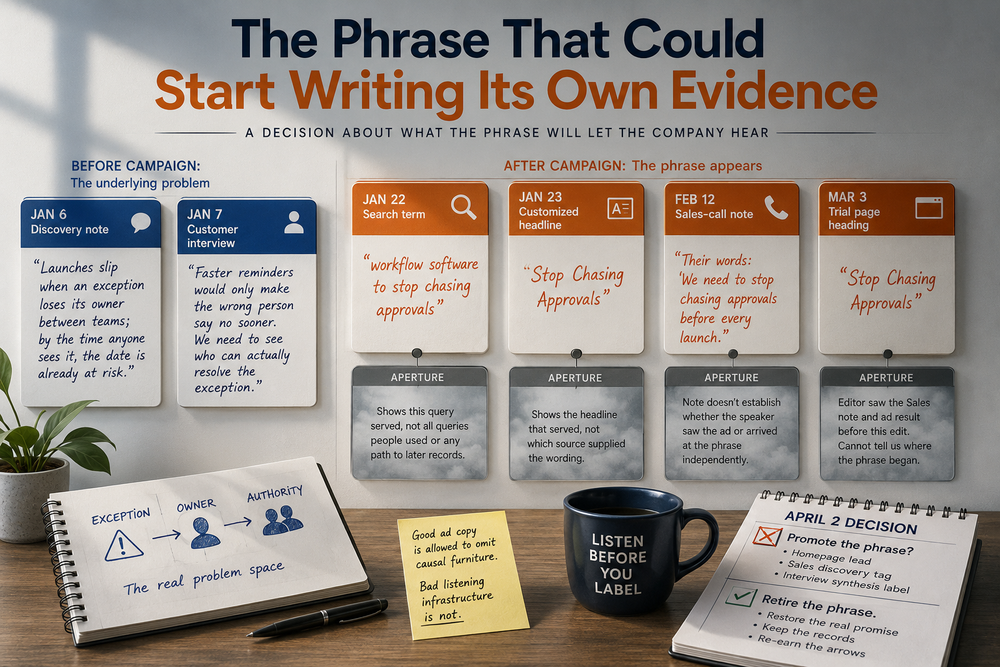
On April 2, Product and Sales at a workflow-software company have to decide whether one successful Search line should become three things at once: the homepage lead, a Sales discovery tag, and the labels used in next quarter’s interview synthesis.
The line is “Stop chasing approvals.” It appeared in a January search term. The next day, the same words appeared in a customized Search headline. The headline performed well. Three weeks later, a sales-call note attributed the phrase to a prospect. In March, the trial page adopted it.
Two questions are hiding in that neat sequence. The first is about provenance: did different people independently name the benefit, or did the phrase circulate among query, ad, conversation, and page? The second is about authority: whatever its origin, what will the phrase train Sales to hear and Research to count once the company builds it into how those teams listen?
The first question can remain unresolved. The second cannot. Promoting the line would not merely broadcast a message; it would begin shaping the company’s future evidence.
The alternative is to remove the trial heading, restore the old product promise—“See exceptions and owners before a launch slips”—and keep the phrase out of the company’s product and category vocabulary.
Four sightings. Search, ad, customer, product. It looks like the market conducted a small focus group without the catering invoice. But this is not only a vote on whether the market led. It is a decision about what the company will let the phrase lead.
Before anyone votes, remove the arrows—and compare the orange words with the blue ones.
This workflow-software company, its records, and its dates are a controlled fiction. The reporting limits are real; the case is constructed so we can inspect a decision that live data often makes harder to see.
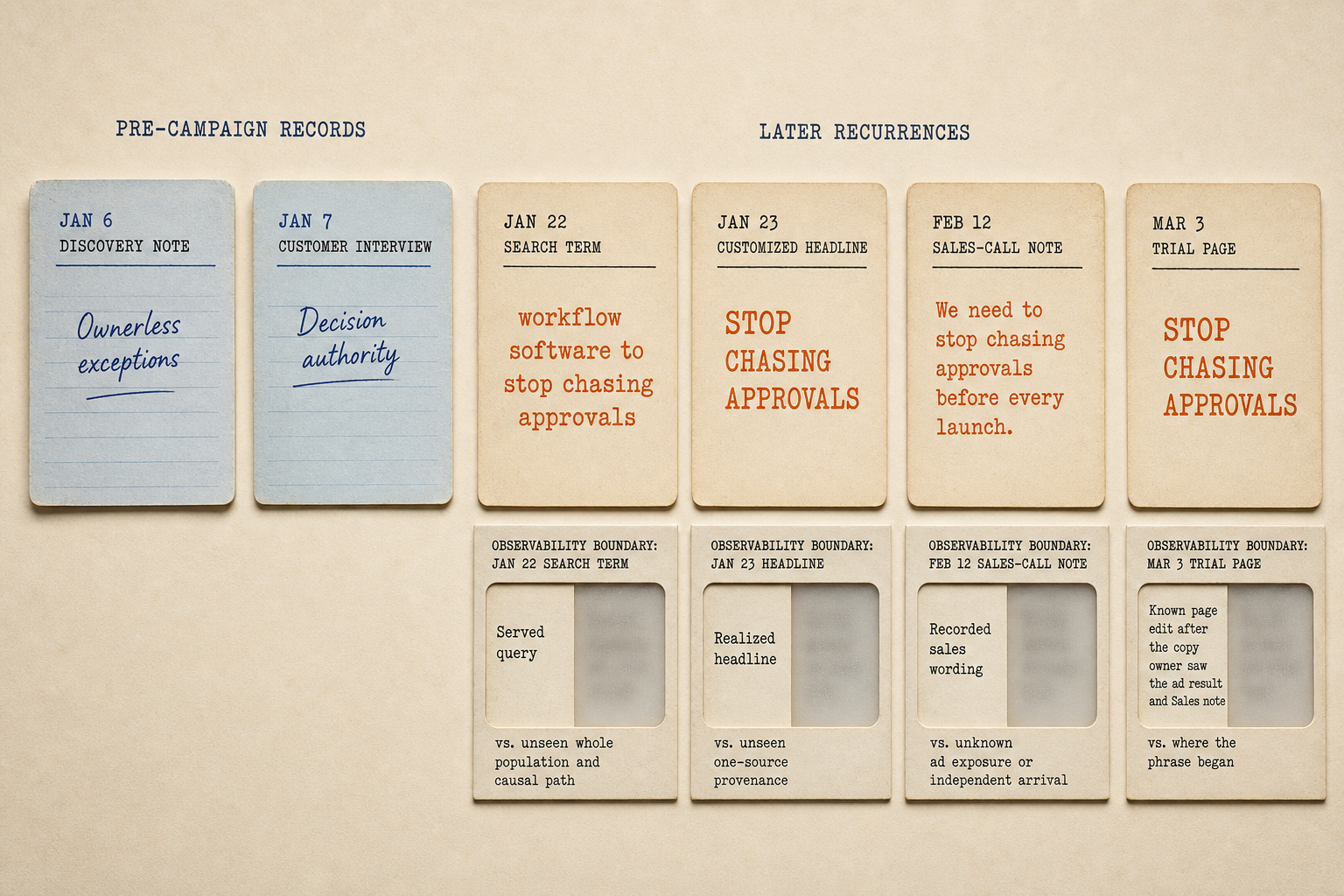
Orange shows the phrase recurring. Blue preserves the problem it may be compressing. Each fogged aperture shows where observation ends. The route can stay unresolved. What the phrase gets to govern cannot.
Six records, two stakes
The two blue cards are the company’s entire pre-campaign record in this case:
| Date | Surface | Exact language |
|---|---|---|
| January 6 | Discovery note | “Launches slip when an exception loses its owner between teams; by the time anyone sees it, the date is already at risk.” |
| January 7 | Independently recruited customer interview | “Faster reminders would only make the wrong person say no sooner. We need to see who can actually resolve the exception.” |
Neither contains the words “stop chasing approvals.” Both describe the product’s underlying territory: ownerless exceptions and unclear decision authority.
Then the phrase appears four times:
| Date | Surface | Exact language | What this record cannot tell us |
|---|---|---|---|
| January 22 | Search term | “workflow software to stop chasing approvals” | It shows that this query served, not every query people used or any path from this search to the later records. |
| January 23 | Search headline labeled as customized text | “Stop Chasing Approvals” | It shows the headline that served, not which source supplied the wording. |
| February 12 | Sales-call note | “Their words: ‘We need to stop chasing approvals before every launch.’” | The note does not establish whether the speaker saw the ad or arrived at the phrase independently. |
| March 3 | Trial heading on one product page | “Stop Chasing Approvals” | The copy owner saw the Sales note and ad result before making the edit, so this record cannot tell us where the phrase began. |
Google’s documentation for text customization and AI Max reporting does not give this company a one-query-to-one-headline trail; the later records do not establish independent origins either. That is the only reporting limit the decision needs.
The first thing recurrence proves is circulation. It does not prove four independent acts of naming.
That is enough provenance work for now. The April 2 choice does not need a solved origin story. It needs a judgment about what the phrase is fit to become.
A phrase does not need a pure origin to become true
The easy argument has two sides. If advertising introduced “stop chasing approvals,” then the language is contaminated voice-of-customer data. If a customer introduced it, the market has spoken.
Neither side survives much contact with language.
A seller can coin a phrase that gives buyers a cleaner handle for something real. People do not become ventriloquist’s dummies when a company supplies words that fit their experience. The words can become genuinely shared through use.
A customer can also coin a phrase that names the wrong mechanism. Customers can describe the symptom they feel most sharply, ask for the fix they already imagine, or leave an adjacent problem outside a wonderfully quotable sentence.
A phrase’s family tree and its fitness are different things. Origin changes what the company may claim about independent demand. It does not decide whether the phrase deserves authority over the product—or over future research.
That is the generous paradox in the orange cards: the wording may have been taught and still be true. The dangerous possibility is not that the phrase is fake. It is that a partly true phrase is about to get a much bigger job.
The phrase changes jobs
On January 23, “Stop Chasing Approvals” is an ad headline. Its job is to earn attention and make a relevant promise under campaign conditions. It performed well. That is evidence for that job.
By March 3, it is a trial-page heading. Now it interprets the product before a visitor does.
The April proposal would promote it again: first into a Sales discovery tag, then into the labels used to synthesize interviews. Those jobs are not more placements for the same copy. They change the direction of influence.
A headline speaks. A discovery tag directs attention. A synthesis label becomes institutional memory.
The phrase did well in the first job. That result is not a reference for the listening jobs.
What “approvals” edits out
The blue records carry three important objects: an exception, an owner, and the authority to resolve it.
The orange phrase carries two: a chaser and an approval.
That is excellent compression. It may also be the wrong compression.
“Stop chasing approvals” catches the lived irritation: the Slack nudge, the calendar slip, the person who has become a human read receipt. It sounds like relief. It is short enough for a headline and broad enough for many operators to recognize themselves in it.
But the January 7 interview has already warned us about the solution hidden inside that framing: “Faster reminders would only make the wrong person say no sooner.” If the real failure is that an exception has no visible owner, or that the named owner lacks decision authority, then chasing is downstream. The phrase puts the runner in the foreground and the decision system out of frame.
That omission is survivable in an ad. Good ad copy is allowed to leave causal furniture off the page. It becomes consequential when the phrase starts organizing what the company hears.
Imagine a future prospect saying, “An exception bounced between teams and nobody knew who could clear it.” A rep using the “approvals” discovery tag can reasonably file that call under approvals. A researcher using the same synthesis label can reasonably group it with other approval stories. Nobody has fabricated a quote. Nobody has even behaved badly.
But the exception, the missing owner, and the absent authority have all been put in the approvals drawer.
By quarter’s end, the synthesis can honestly report that approval language keeps recurring. The homepage line now appears freshly validated by customer research. The phrase has begun writing the evidence for its own promotion.
This is why it may be good ad copy and bad listening infrastructure.
Performance cannot resolve the difference. A strong headline result says the wording performed under the campaign’s measurement conditions. It does not say the room was accurately named.
Paid search is both a microphone and a participant. That is not a scandal; it is the medium. The mistake is letting the participant quietly choose the labels under which its effects will later be counted.
The April 2 decision
On the evidence in front of us, I would retire the phrase from product and category vocabulary.
Restore “See exceptions and owners before a launch slips” on the trial page. Do not make “Stop Chasing Approvals” a homepage lead, a Sales discovery tag, or an interview-synthesis label.
Not because the phrase might have come from the seller. Because it has not earned the authority the proposed uses would give it.
Retirement is not erasure. Keep the six records. Preserve the search term and the ad result as a promising message hypothesis. In future interviews, record known campaign exposure, ask people to describe the failed launch before offering any label, and keep rival descriptions visible instead of translating them into “approvals” on contact.
The decision can reopen when independent or exposure-aware evidence shows that buyers use the phrase to recover—not replace—the underlying mechanism: the exception, the owner, and the person who can actually resolve it. If “stop chasing approvals” still fits after those concepts are allowed to speak in their own words, it may deserve promotion.
Keep the fogged windows. If the arrows are real, earn them.
Until the orange words can carry what the blue records know, they do not get to decide what the company hears next.