
The New Ad That Improved Last Week
"What did you optimize this week?"
Mara ran paid search for a B2B software company. Elise, its demand generation director, was trying to secure an autumn budget increase.
Nine days earlier, Mara had launched a 50/50 broad-match experiment. The campaign spent about $3,600 a week and optimized toward sales-accepted demos. Its median click-to-demo delay was twelve days.
The split was holding. Tracking worked. Spend paced. Search terms contained no new species of disaster. Most of the clicks had not had their normal chance to become demos.
"Nothing," Mara said.
There was a silence.
"Nothing?"
"Nothing material is broken. If I edit the test now, I don't speed up the answer. I replace the question."
"I understand conversion lag," Elise said. "But the dashboard says $240 CPA, and tomorrow my CRO will ask what the agency did about it."
"Based on nine-day-old clicks?"
"He will not ask how old the clicks are."
Elise was not foolish. Her problem was that Mara's judgment had no surface area. Observation and neglect looked identical from the client's chair: no edits. The red CPA, meanwhile, was visible from space.
That afternoon, Mara did what competent people do when competence needs to leave fingerprints. She ended the experiment, tightened tCPA, added negatives, moved budget, and replaced an RSA with a new proof-point asset.
The change log looked magnificent. All verbs.
Next Monday, Elise arrived cheerful.
"CPA is down to $200. Great recovery. Sales loves the new proof point."
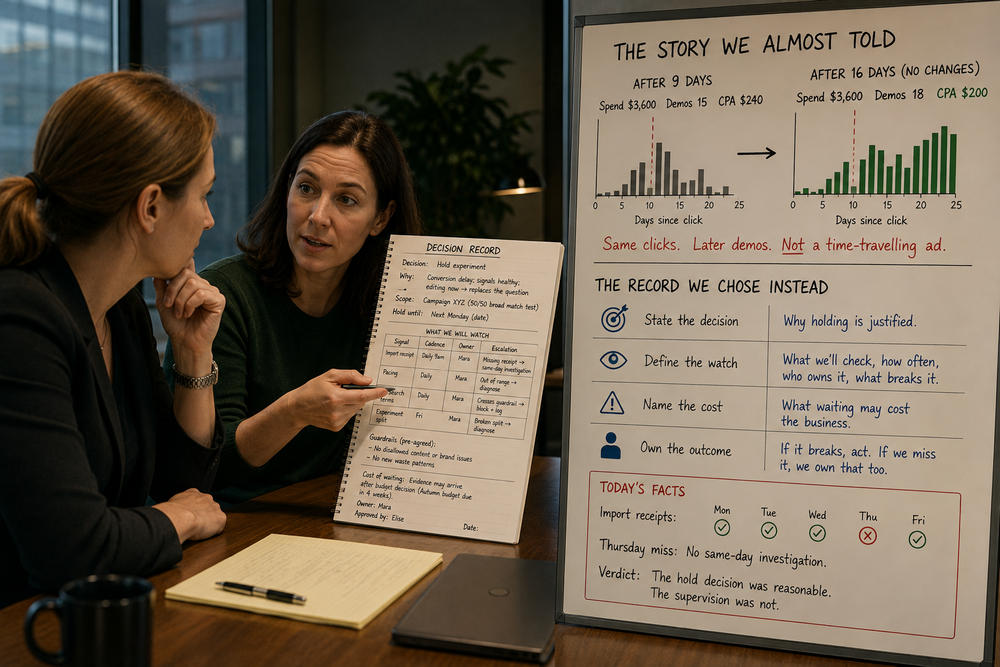
Mara opened the seven-day click cohort that had ended before the edits. The campaign had spent $3,600 and, as of the previous Monday, recorded fifteen accepted demos: $240 each. Three more demos from those same clicks had arrived during the week. The same old spend now had eighteen demos: $200 each.
This is ordinary Google Ads timekeeping with a theatrical consequence. Its primary conversion columns report a conversion back on the date of the ad click, while recent performance can look worse until delayed conversions arrive. The old week had improved without acquiring a single new click.
"The new ad improved last week," Mara said.
"Excellent."
"No. I mean it would have needed to. Those clicks happened before the ad existed."
Elise paused. "So we have invented time-travelling copy."
"That is one interpretation."
"And the other?"
"The number matured."
The proof-point asset might have been excellent. Broad match might have been a disaster. This result established neither. The late demos belonged to old clicks, the control was gone, and four edits now shared one flattering before-and-after story.
They had not merely interrupted learning. They had manufactured knowledge.
That knowledge was useful. It gave Elise a recovery story for the CRO and Mara an optimization for the QBR. If nobody objected, "proof-point copy lowers CPA" could become an agency playbook, then an onboarding lesson, then the reason somebody replaced good copy in three other accounts.
Later outcomes often change how people grade an earlier decision even when the outcome added no information the decision-maker could have used. Researchers call that outcome bias. Agency life adds a special convenience: the change log supplies a plausible hero.
Mara rebuilt the experiment.
When the new test was nine days old, the Monday question returned.
"What did you optimize this week?"
"Nothing," Mara said. "But I brought a document that can prove I was negligent."
"That is not the agency positioning I expected."
"Give it a minute."
The note began with the decision: leave targets, budgets, match types, negatives, and assets unchanged through next Monday.
"Why next Monday?" Elise asked.
"Because the recent clicks are still inside the account's normal delay, and the account is healthy enough to wait. Monday is the next useful review—not a promise that the test will have an answer."
"What does healthy enough mean?"
"The offline-conversion import is arriving, spend is pacing, the experiment split is intact, and search terms have not crossed the guardrails we already agreed."
"Those are today's facts. What are you doing until Monday?"
Mara added the watched signals. She would check the import receipt by nine each weekday, review pacing and search terms daily, and check the split on Friday.
"And what ends the hold?"
"A missing receipt gets a same-day tracking investigation. A broken split gets diagnosed before we read performance. A term that crosses the existing safety guardrail gets blocked and logged as an exception. No waiting for Monday."
"Who owns those checks?"
"I do."
"When do we declare a winner?"
"The experiment brief already owns that. A hold note shouldn't smuggle a new answer into an old test."
"Autumn budget is due in four weeks."
"Then the evidence may arrive after the business decision. Put that in the record too."
They did. If budget came first, Elise would own the provisional allocation. She could choose under uncertainty, but she could not call her choice an experiment result.
Elise read the note again.
"So this isn't a list of things you didn't do."
"It's a list of things I claim to be doing while I don't touch the settings."
"And if you ignore one?"
"You have it in writing."
On the next Monday, Mara opened the record before the dashboard.
"Import receipts," Elise said.
"Monday, Tuesday, Wednesday—present. Friday—present."
"Thursday?"
Mara looked again.
The Thursday receipt was missing. An upstream CRM job had failed. It recovered on Friday, but Mara had not noticed the missed run at nine as promised. She had glanced at the Google Ads dashboard after lunch, found nothing alarming, and assumed the plumbing was intact.
"Did you start a same-day investigation?" Elise asked.
"No."
"Then according to your record, Thursday required action."
"Yes."
"Was leaving the campaign alone wrong?"
"No. Failing to watch the signal was wrong."
The document created to defend Mara had become evidence against her. This was not an unfortunate side effect. It was the first proof that the thing worked.
Without the record, the week offered a familiar argument. Mara could point to unchanged settings and call it disciplined restraint. Elise could point to unchanged settings and call it neglect. Neither could prove anything.
Now they could separate the campaign decision from the management of it. The decision to hold had been reasonable. The claim that Mara actively supervised the hold had been false for one day. The account outcome—good, bad, or merely late—could not travel backward and repair that.
Elise put on her CRO voice.
"What did the agency do this week?"
"Protected the experiment, missed one check it had committed to, learned that the import recovered without us, and documented the miss."
"Not very glossy."
"No."
"I can use it."
Visible motion wins because platforms preserve every touch. A target moves; a budget shifts; an asset appears. The operator gets a timestamp for free. Observation leaves no such trail unless somebody states, before the result, why waiting is justified, what must be watched, what will force action, who owns it, and what waiting may cost.
That record is not a prettier way to say trust me. It is a claim designed to survive—or fail—a later inspection. If it can only acquit the operator, it is change theatre performed at a lower volume.
A change log proves the account moved. A decision record proves somebody claimed to be steering—and gives the client enough evidence to decide whether they were.