
The Ad Change That Never Touched the Ad Account
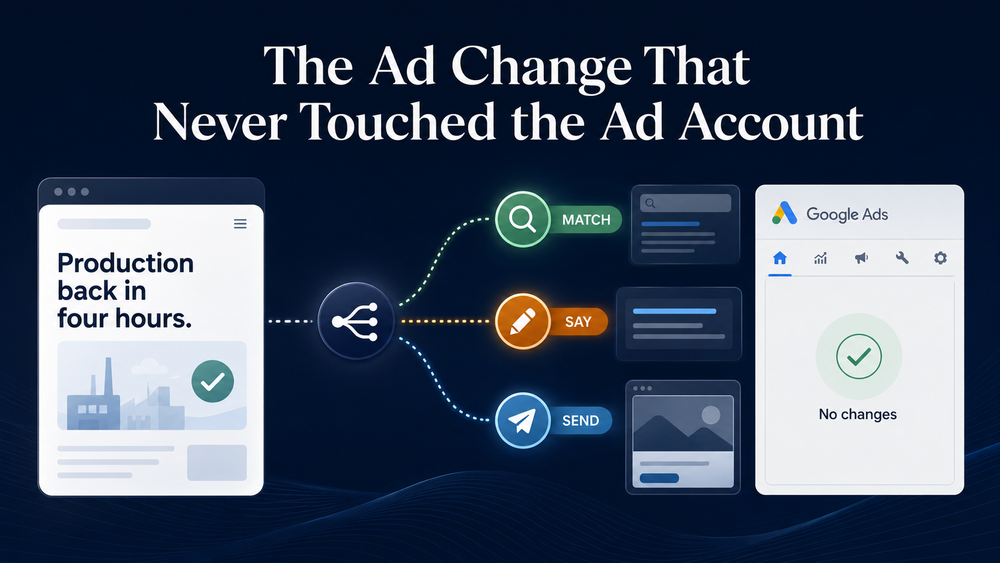
At 4:12 on Thursday afternoon, a web producer at an imaginary backup company
publishes one new page.
The headline says “Production back in four hours.” The sentence underneath
contains the part that makes the promise true: it is for Continuity-plan
customers whose environments have passed a readiness review.
It is an ordinary release. The producer updates no feed. The paid-search
operator changes no keyword, ad, bid, setting, or URL. Google Ads Change History
remains serenely empty, like a security camera pointed at the wrong door.
But three AI Max-enabled Search campaigns use the same public domain. The new
page may now help Google decide that the company is relevant to a search it did
not match yesterday. Its language may help shape a headline. The page itself may
become the destination.
Nothing in that paragraph says an ad will serve. It says the release changed
what the system has available to consider. That distinction—between a changed
input, an eligible possibility, and an actual journey—is the whole machine.

The dotted routes are possibilities, not a promise of serving. The desks below
represent separate campaign-local controls; the public page has no website-wide
“never amplify this” switch.
One page, three possible jobs
AI Max is an optimization layer inside a Search campaign, not a separate
campaign type. Its parts can use a website in three materially different ways.
Calling all three “automation” hides the useful part.
MATCH: the page can help make a search eligible. Before Thursday, the phrase
“four-hour production recovery” may have had no useful counterpart on the site.
After Thursday, the new page could help a campaign match a search such as “fast
ransomware production restore.” Google says AI Max search term matching learns
from the campaign’s keywords, creatives, and URLs. It uses broad-match,
asset-based, and landing-page-based technology to find searches beyond the
advertiser’s existing keywords. In reporting, Google calls one source AI Max keywordless: a match derived from website content or landing pages without
requiring a keyword. A new page can therefore add meaning to the matching
system, not merely somewhere for a click to land. (How AI Max
works, Google Ads
API reporting)
SAY: the page can supply language. The same release could contribute a
headline such as “Production Back in Four Hours.” Text customization makes
additional headlines and descriptions from the domain, landing page, existing
ads, and ad group keywords. It can extract from titles, descriptions, and meta
tags, and it can generate new text grounded in landing-page content. Google says
these assets are reviewed and refreshed as needed at least every 48 hours; when
a landing page changes, its customized text assets are refreshed within 48
hours. That timing applies to text assets, not to every other AI Max decision.
(About text
customization)
SEND: the page can become the door. Or the new page could receive the click.
With Final URL expansion on, Google may replace the ad’s supplied final URL with
a query-relevant page on the domain that is themed to the ad group. It may
generate text to fit that selected page. Final URL expansion is a campaign-level
setting and is enabled by default when an advertiser opts in to AI Max. (About
Final URL expansion in
Search)
Those are three different possibilities, not a guaranteed sequence. The auction
can still choose another ad, another headline, another page—or no ad from this
company at all.
The release changed which routes were available. The auction still controlled
the gate.
Why Change History can be perfectly clean
Google describes Change History as a record of changes made to the Ads account:
ads, assets, bids, budgets, keywords, targeting, settings, API edits, Editor
edits, and similar mutations. A CMS publish is outside that ledger. (Review
your account history)
This makes the familiar forensic question—“Who changed the account?”—too small.
Sometimes nobody did. The account kept its instructions while the public world
those instructions can read changed underneath it.
That is also why a website release should not automatically be called an ad
change. Most pages will never cause a new impression. Even a highly relevant
page is only one input among queries, assets, campaign settings, bids, predicted
performance, policy checks, and the auction. The precise statement is more
useful: a release on an ad-reachable domain can change paid-search possibility
without changing paid-search configuration.
The one-page permission everyone goes looking for
Suppose the four-hour promise may remain public because the page supplies its
eligibility conditions. The business simply does not want AI Max to foreground
that promise or use that page in any automated journey.
The desired instruction is easy to say:
Keep this page out of MATCH, SAY, and SEND across every campaign that can draw
from this domain. Leave everything else alone.
Google’s current public controls do not describe one dependable page-specific,
cross-campaign permission that means all of that.
At Campaign A’s desk, our operator tries the closest-looking control: a URL
exclusion. For a moment, it looks like the answer. Then the grammar changes.
She needs not this source. The exclusion can say not this destination—SEND,
in A. It can block the page from serving through Final URL expansion, but MATCH
and SAY remain available, and Campaigns B and C have not received the
instruction. Google documents URL exclusions as campaign-level controls for
Final URL expansion, not as domain-wide denials of a page as source material for
matching or generated text. (AI Max setup and URL
controls)
She moves to SAY. Another near-answer: text guidelines can say not this
wording by keeping exact words or phrases out of generated assets and
forbidding concepts or styles. But they cannot say not this page. They govern
what generated text may say, not whether a page may be used. They are an
experimental beta, campaign-level, and apply to assets made with text
customization. The exact-term list is capped at 25 entries per campaign;
messaging restrictions at 40. Copied guidelines become independent copies. They
do not govern matching or destination selection. (Use text
guidelines)
She tries MATCH. A negative keyword can say not this search. It rejects a
search pattern, not a page. Turning search term matching off would stop the
whole capability at ad-group level, not withhold one page. Turning text
customization or Final URL expansion off creates the same broader loss at
campaign level.
The closest broader SEND fallback is an allowlist, not another page-specific
answer. Turn Final URL expansion off in every relevant campaign. Then, in each
relevant ad group, use URL inclusions or a labeled page feed to name the dynamic
landing pages that are allowed. The team must maintain those allowed sets, and
pages outside them cannot be selected dynamically.
AI Max has controls. What it lacks is one place to deliver the whole instruction.
A URL exclusion handles SEND at A. Text guidelines handle SAY, but not the page.
A negative keyword handles the query, not the source. None expresses one
page-wide instruction across MATCH, SAY, and SEND for A, B, and C.
The promise can travel farther than the permission.
When the one-page permission does not exist
If one public sentence is safe only when it stays tucked beside a qualifier,
and the platform offers no page-wide “do not foreground” permission, the
remaining choices start with the sentence and move outward.
Change only the words: make the public sentence safe on its own. “Eligible
Continuity customers: four-hour production recovery after readiness review” is
less seductive than “Production back in four hours.” It is also less dependent
on a paragraph arriving with the headline. Landing-page titles, descriptions,
and meta tags deserve particular suspicion because Google names them as
extractive sources. H1s and other visible claims remain part of the broader
landing-page content that grounds generated text. Safer source wording reduces
the mismatch; it is not a guarantee about what any generative system will write.
Change the site’s reach: move the sensitive material beyond all three routes,
or narrow SEND. One design separates domains: sensitive documentation lives
outside the advertising domain that supplies URLs and landing-page content to
the campaigns. The boundary is architectural, not a hidden platform control:
that material is no longer on a domain those campaigns can draw from for MATCH,
SAY, or SEND. The other design governs SEND alone: Final URL expansion stays
off in every relevant campaign, and each relevant ad group gets the intended
URL inclusions or page-feed inclusion criteria. The first separates the site
into an ad-reachable surface and a non-ad-reachable one. The second requires
ongoing allowlist maintenance and gives up dynamic landing-page selection
outside the allowed set.
Change the campaigns: accept broader controls or repeat local ones across the
whole scope. Disable the relevant automation, restrict dynamic pages to an
allowlist, or repeat exclusions and text restrictions across every campaign in
scope. The cost is not theoretical: the business is choosing less matching,
less generated creative, fewer dynamic destinations, or more maintenance in
exchange for confidence.
Or remove the claim from the ad-reachable public surface altogether.
That is not a paid-search failure.
Sometimes the platform’s inability to express a narrow permission reveals that
the desired publishing policy was fiction.
Let releases move; make the consequential ones visible
The answer is not a standing approval meeting for every new FAQ and typo fix. It
is to stop pretending the Ads account is the complete boundary of paid media.
First, keep a small map of which public domains feed which automated campaigns.
That is a more durable object than a list of “paid landing pages,” because Final
URL expansion and keywordless matching are specifically designed to move beyond
that list.
Then let the release system send the paid-search operator a compact diff when a
page on one of those domains changes a title, H1, meta description, price,
availability statement, guarantee, eligibility rule, geography, or delivery
time. The web team still publishes normal work. The rare consequential release
arrives with the URL and the sentences that changed—not a calendar invitation
called “stakeholder alignment.”
The operator has one human question to ask:
Would this claim remain true and acceptable if a search ad made it the
largest sentence on the screen?
If yes, the release can be treated as ordinary input. If no, the team must
choose safer wording, a real architectural boundary, or the wider loss of
automation. A notification cannot manufacture a permission the platform does
not offer.
Look in the journey report, not the empty ledger
After the auction turnstile, reporting can turn the three dotted possibilities
into an observed journey. Start with the “Search terms and landing pages from
AI Max” view, which connects each reported search term to its headline,
landing page, campaign, and ad group. Add the Source column there to
distinguish broad-match expansion from keywordless matching. Separately, asset
reports identify Google AI text, and landing-page reports identify Final URL
expansion URLs. (About AI Max
reporting)
Taken together, those surfaces can show the search term and source for MATCH,
the Google AI headline for SAY, and the Final URL expansion landing page for
SEND. This is evidence of a reported journey, not proof of every possibility.
Some low-volume queries are withheld by privacy thresholds and appear only
inside totals. An unseen page’s absence cannot prove it was impossible, and no
report can retroactively grant permission.
On Monday morning, our operator may still open a clean Change History. But now
the cleanliness is no longer reassuring or mysterious. She checks the web
release, then the query–headline–landing-page journey, then every campaign that
shares the domain.
Publishing does not guarantee an impression. It puts a sentence on the auction
table.