
I made SQL Primary after form leads fell. Why did Search impressions and clicks drop?
The SQL-only switch may have changed Search bidding, but a first-week reach drop has other possible causes. Check the selected goal, HubSpot imports, lag and auction losses before deciding whether to wait, repair or reverse.

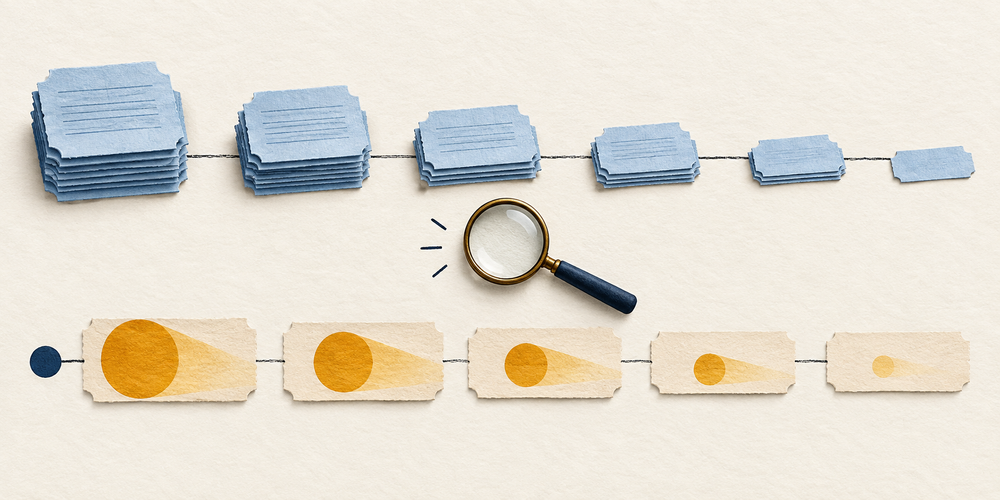
The SQL-only change is a plausible reason for the new drop in Search impressions and clicks, but one week cannot identify it as the cause. The form decline began while several funnel stages were goals; the reach decline came after SQL was made Primary. First establish what this campaign is actually bidding toward, whether its SQL signal reaches Google Ads, and whether anything else changed. Then judge a matured set of leads, not the height of this week's bars.
The two declines deserve two timelines. Reversing the SQL switch cannot, by itself, explain why forms had already gone from a steady month to several weaker weeks. And delayed SQL reports cannot, by themselves, make a real impression or click disappear. The useful question now is: did delivery change, and if so, what changed at the same time?
“Primary” is a setting; the campaign goal is the assignment
Suppose one person clicks, submits a form, becomes a marketing-qualified lead (MQL), then a sales-qualified lead (SQL), then a customer. Those are four legitimate milestones for one lead. Their presence in All conversions does not mean four customers were acquired. A repeated upload of the same SQL is a duplicate to handle within that SQL action; a later won event is new information worth keeping. Google recommends separate actions for separate lead stages, and HubSpot says a contact moving through multiple configured lifecycle stages can sync an event for each. Google Ads offline-import FAQ · HubSpot lifecycle-event guidance
Open this Search campaign's Settings → Conversion goals. Is it using account-default goals or campaign-specific goals? Expand the selected goals and inspect their actual conversion actions. In standard goals, a Primary action is a bidding action only when its goal is selected for the campaign. A Secondary action remains in All conversions for observation. There is a consequential exception: an action included in a selected custom goal can be used for bidding even if that action says Secondary. If a custom goal still contains forms, MQLs or won deals, “SQL alone is Primary” does not establish “SQL alone is the bidding signal.” Segment the campaign's conversions by action to check what its Conversions column contains. Google Ads conversion-goal guide
Keep the earlier funnel stages measurable while you make this check. Turning them Secondary in the relevant standard goals can preserve a view of their history without asking this campaign to maximize every rung at once. That visibility matters: a bid strategy can seek SQLs while you still need to know whether forms and won deals are moving with them. The Conversions column describes selected bidding actions; All conversions is a wider report, and neither column alone counts unique people across stages. Google Ads conversion-goal guide
Here is the route by which the switch could affect reach: Google sets auction-time bids to pursue the campaign's selected conversions. Changing that selection from forms or mixed stages to SQL can change which auctions look worth bidding on, so impressions may change before there is enough mature SQL data to judge the result. If a target CPA is also still priced for the cheaper form event, the constraint can tighten further. But untargeted Maximize Conversions is designed to spend the campaign's budget; a sharp spend collapse deserves a serving and measurement investigation, not the comforting label “learning.” Google Ads Maximize Conversions guide · Google Ads goal-change guide
Follow the SQL back to the click
An SQL in HubSpot is not automatically an SQL Google Ads can attribute to this campaign. For a handful of recent, eligible contacts, trace the click identifier or matching data, the form, the lifecycle-stage change, the HubSpot event, and the corresponding Google Ads conversion action. Check that the event is enabled and mapped to the intended Ads account; inspect Google's offline-data diagnostics for upload errors and missing attribution. HubSpot notes that its lifecycle event needs a click ID or shared contact data to sync, and that stage changes from before the event was created are not counted by that HubSpot setup. Google's import guide distinguishes an uploaded event from one processed and attributed in reporting. HubSpot lifecycle-event guidance · Google Ads offline-import diagnostics
Now measure the delay from ad click to SQL, including CRM qualification and upload time. Compare HubSpot's stage-change dates with Ads' click-date reporting, or use Ads' “by conversion time” columns for the appropriate comparison. A person who clicked last week may become an SQL next week; a person who became an SQL last week may have clicked much earlier. Google explicitly warns against comparing uploads by upload date with its ordinary conversion report. A thin first-week SQL count can therefore be an unfinished clock rather than a verdict on the new goal. Google Ads offline-import diagnostics · Google Ads conversion-lag guide
This also prevents a tempting calculation: dividing “this week's SQLs” by “this week's forms.” The numerator and denominator may contain different people from different click weeks. A funnel should be followed as a cohort, not assembled by borrowing this week's SQLs from last week's forms and calling the resulting fraction a conversion rate.
Check whether the auction changed
Compare complete, like-for-like days immediately before and after the SQL switch. Put impressions, clicks, spend, average CPC, Search impression share, and Search lost IS (rank) beside the campaign's change history and bid-strategy status. Check budgets, any target CPA, keywords, location, schedule, ad approval and other edits. Google's change history places edits against performance; its Search troubleshooting guide names conversion tracking, bids, budget, targeting, policy and auction dynamics as distinct causes of fluctuations. Google Ads change history · Search fluctuation guide
The columns answer different questions. Search impression share is impressions received divided by estimated eligible impressions; Lost IS (rank) estimates missed auctions from Ad Rank. A higher rank loss with lower spend after a goal or target change makes changed bidding a credible line of inquiry; it does not prove that the goal change alone did it. Falling impressions with a roughly steady share could reflect a changing pool of eligible searches, though targeting and eligibility still need checking. Falling clicks with fairly steady impressions calls for a look at click-through rate before blaming reach. For Maximize Conversions without a target, do not diagnose budget loss from Lost IS (budget): Google says that column is incompatible with the strategy. Look at actual budget and spend instead. Google Ads impression-share definitions · Google Ads Maximize Conversions guide
If a target CPA is in use, read its number in cost per SQL, not cost per form. An unchanged form-level dollar target can become far tighter when the selected action becomes rarer. Google recommends adjusting a target to the historically achieved CPA of the lower-funnel event during such a transition and allowing for conversion delay. If this campaign uses Maximize Conversions without a target CPA, there is no target to “fix”; inspect the actual bid strategy rather than assuming one. Google's transition guidance describes possible temporary performance disruption and learning over conversion cycles. It does not say this first-week drop must be harmless. Google Ads lower-funnel transition guide · Google Ads goal-change guide
Give the smaller funnel a fair denominator
Take a range of ad clicks old enough for most of those leads to have had time to become SQLs. Join the associated leads across form, MQL, SQL and won stages; count each lead once within each stage. Carry the same click cohort's spend through to cost per form, cost per SQL and, when enough time has passed, cost per won deal. Record the share that cannot be joined or attributed rather than quietly treating missing matches as failures. If the typical click-to-SQL interval is two weeks, last week's clicks are too young for an SQL-rate comparison. If the won stage takes months, call its recent count provisional.
If the historical join is missing, do not invent the old funnel. Click IDs or another usable link between paid clicks and CRM contacts may never have been stored; past cost per SQL and cost per won deal for those click cohorts may be unknowable. Start a prospective record: retain a permitted click identifier or matching key with the lead, its campaign source, click date and dates of form, SQL and won stages, then verify that current HubSpot SQLs reach the intended Ads action. This will support a same-lead comparison once those clicks have matured; it cannot recover an unjoinable past.
Until then, a broken current import is a defect to repair now. If current imports are sound and delivery and spend remain within an affordable limit, set a review date and observe while the first prospective click-to-SQL lag becomes known. If a verified, material serving loss continues and the business cannot wait for that cohort, provisionally return to the last verified goal while keeping SQL visible, then reconsider when the new cohort matures. That is a risk decision under missing history, not a claim that the earlier goal produced better SQL economics.
For illustration only, imagine one mature click cohort cost $800 for 80 clicks, 10 forms, 4 SQLs and 1 won deal. A later cohort with settled sales outcomes cost $600 for 50 clicks, 6 forms, 4 SQLs and 1 won deal. Reach and forms fell, but cost per SQL went from $200 to $150 and cost per won deal from $800 to $600.
In an alternative $600 cohort old enough to judge SQLs, suppose there is only 1 SQL: its observed cost per SQL is $600. If that lead's sales deal is open, eventual won economics are unknown; do not count it as a loss. If the deal has closed without a win after the normal sales window, the cohort has zero observed wins and no cost-per-won figure to compare. The SQL-cost case for accepting lower reach has weakened in either version; the won-stage judgment depends on the actual sales outcome. These are alternative hypothetical outcomes, not evidence about any particular account.
There is no hard 30 SQLs in 30 days eligibility gate for Maximize Conversions; Google's stated prerequisite is conversion tracking. More timely, accurately attributed SQLs make a deeper goal easier to assess and can give the bidder a better signal; sparse, delayed events increase uncertainty. Google's guidance frames a transition in conversion cycles, not a magic monthly count. Google Ads Maximize Conversions guide · Google Ads lower-funnel transition guide
Observe, repair, or reverse?
Observe for a measured interval if SQL really is the selected bidding action, imports are healthy, no other serving problem appears, and the first-week cohort is younger than the observed click-to-SQL lag. Keep budgets and targets deliberate rather than editing them daily; revisit after enough of a conversion cycle has elapsed. Track spend now and cost per SQL once a joined cohort matures, not just impression recovery. Google Ads goal-change guide
Repair the specific defect now if the selected goal still includes unwanted actions, SQL uploads or attribution are failing, a target CPA is still priced as a form, or another concurrent change explains the reach loss. Waiting does not heal an import that never arrives.
With mature cohorts: If real delivery loss persists beyond a sensible lag window and mature SQL economics do not justify it, return to the last verified goal or compare goal choices with a controlled campaign test.
Without a joinable history: If a verified, material serving loss continues beyond what the business can tolerate while prospective evidence matures, a provisional return to the last verified goal may be justified.
Reversal buys back a more frequent signal at the cost of optimizing for an earlier, less qualified event. A comparison costs time and traffic, which may be scarce in this campaign. Neither choice follows from the first week alone.
The answer to “why did impressions and clicks drop?” is still conditional: the SQL-only switch may have changed bidding, especially if its lower volume or a form-sized target constrained auctions; an import problem or an unrelated serving change may also be involved. The checks above can separate those possibilities. A mature, same-lead funnel can eventually tell you whether keeping the deeper goal is worth the reach it appears to have surrendered.