
A Dictionary of Words That Can Block Your Buyers
Free, jobs, DIY and four other words change meaning inside a complete search. Seven illustrated entries for reviewing an inherited negative keyword list.
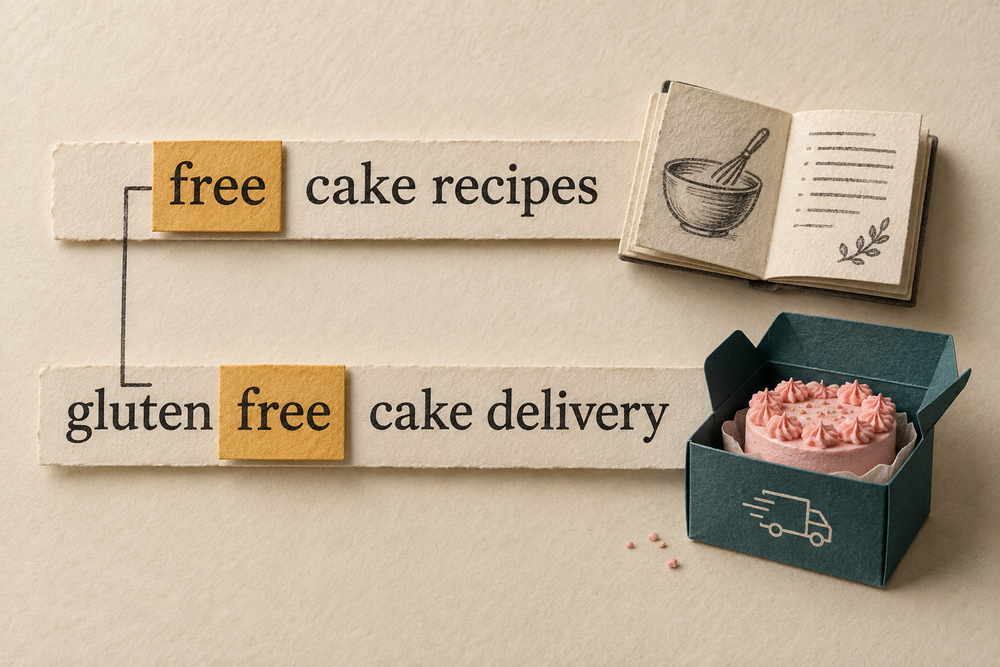
A bakery can lose a cake order to the word free.
The search is gluten free cake delivery. The inherited negative list contains free. Nobody has asked for a free cake. The word names what the cake must leave out.
This dictionary is for that moment: a familiar exclusion starts looking less familiar when you put the rest of the search back around it.
The searches below are invented examples, not account results. Each entry fixes a business and a sales goal, then pairs a search that does not fit that offer with one that could. “Could” matters. A relevant search still needs a suitable offer, a workable acquisition cost and evidence of value.
How to read the exclusions
For these Google Search examples, a one-word broad or phrase negative would block both searches in each pair. Quotation marks around that single word do not rescue its useful meaning. A one-word exact negative behaves differently.
Here, "a phrase" means a phrase negative: those consecutive words, in that order, including in longer searches. [a complete search] means an exact negative: that word sequence without extra words. Google says casing and misspellings are handled automatically; synonyms and singular/plural forms need separate consideration. These examples use literal wording. Google’s negative-keyword rules
A narrower example is a candidate replacement to examine in the stated campaign, not a list to import. Adding it while retaining the broader word does not restore eligibility. Other exclusions may also apply.
Cheap
An absolute limit can hide inside a relative word.

Business: A hotel offering family rooms at $150 a night, with no cheaper rooms available in the advertised period.
| Does not fit this offer | Could fit this offer |
|---|---|
| cheap hotel under 50 dollars | cheap hotel family room |
The first search states a ceiling the hotel cannot meet. The second gives no ceiling. Someone comparing one family room with two separate rooms may find $150 economical. Someone else may find it impossible. The word does not tell you which.
Narrower candidate: [cheap hotel under 50 dollars] removes the stated search; the family-room search remains outside that exclusion.
That is a deliberately small decision. It does not reject every price-sensitive search or assume that a family booking will cover its acquisition cost. Reopen the exclusion when the offer or available rates change. A pricing policy should not survive invisibly in a word list after its premise disappears.
DIY
Doing the installation can be part of buying the product.

Business: A seller of ready-made home alarm kits designed for customers to install, with no Arduino components or programming products.
| Does not fit this offer | Could fit this offer |
|---|---|
| diy alarm arduino source code | diy home alarm kit buy |
The first search asks for material for a different kind of project. The second names the intended installation method of the product on sale. “DIY” can remove a labour purchase while leaving the equipment purchase intact. This is an actual commercial model: SimpliSafe offers customer installation alongside professional installation.
Narrower candidate: "arduino source code" catches that phrase, leaving the ready-made-kit search outside its reach.
Before extending the exclusion to arduino, inspect what else the business sells or supports. A specialist components retailer could want precisely the project this alarm-kit campaign does not serve.
Free
Zero price, or the absence of an ingredient.

Business: A bakery selling and delivering gluten-free cakes; this campaign is for finished cake orders, not baking instruction.
| Does not fit this offer | Could fit this offer |
|---|---|
| free cake recipes | gluten free cake delivery |
One person asks for instructions to make a cake. The other asks someone to bring a finished cake. In the second search, “free” is attached to gluten. Treating it as a price request changes the sentence.
Narrower candidate: "cake recipes" catches the instructional phrase and leaves the delivery search outside that exclusion.
Even the narrower phrase needs its business attached. It would be a different decision for a publisher selling baking subscriptions. For this bakery, the useful boundary is what the customer is asking the business to provide. Neither the presence of “free” nor its absence measures willingness to pay.
Jobs
Which side of the vacancy is the searcher on?
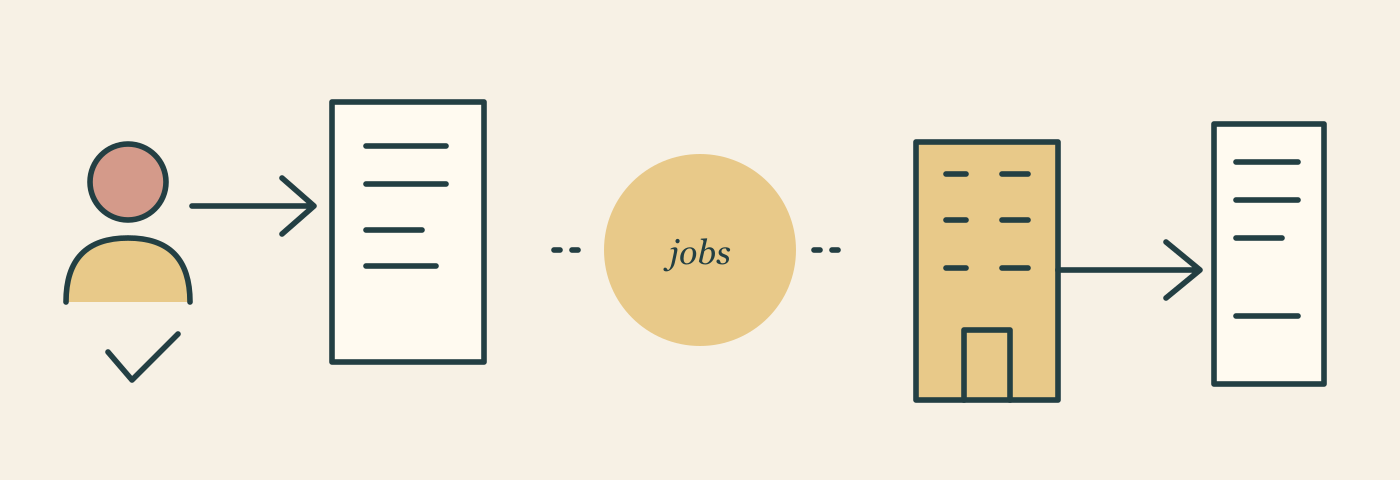
Business: A job-advertising service running a campaign to acquire employers who pay to promote vacancies.
| Does not fit this offer | Could fit this offer |
|---|---|
| warehouse jobs apply online | advertise warehouse jobs |
Both searches concern the same work. Their verbs point in opposite directions. An applicant wants employment; an employer wants applicants. Paid vacancy promotion is a real product—for example, Indeed offers Sponsored Jobs to employers.
Narrower candidate: [warehouse jobs apply online] excludes that applicant search without catching the advertiser search.
Be careful with the tempting expansion to "apply online": “how to let candidates apply online” could be a buyer of recruiting software. Also keep the employer campaign separate from any applicant-acquisition purpose the business has. A word cannot decide which side of a marketplace a campaign should fund.
Manual
The document, or the way the machine works.

Business: A machinery dealer selling conventional mills, with no document-translation service.
| Does not fit this offer | Could fit this offer |
|---|---|
| milling machine manual translation | manual milling machine for sale |
The first search is commercially plausible—for a translator. It is still outside this dealer’s offer. In the second, “manual” describes the equipment. KNUTH’s conventional milling range illustrates the category: machines operated with handwheels or mechanical feed.
Narrower candidate: "manual translation" catches the document-service request while leaving the machine purchase outside the exclusion.
Do not generalize this into “people reading manuals are bad prospects.” A prospective machine buyer can need specifications, installation requirements or operating details before deciding. The narrower choice here depends on a service the dealer does not offer, not a verdict against research.
Reviews
The object of the review matters as much as the word.

Business: A heat-pump installer buying enquiries for residential installations, with recruitment outside this campaign’s purpose.
| Does not fit this offer | Could fit this offer |
|---|---|
| heat pump installer employee reviews before applying for a job | heat pump installer customer reviews |
“Before applying for a job” states an employment purpose that “employee reviews” alone cannot establish. The second search can be a homeowner comparing installers before deciding whom to invite into their house.
Narrower candidate: [heat pump installer employee reviews before applying for a job] addresses that employment search and leaves the customer-review search outside that exclusion.
Keeping the second search eligible does not make it efficient. It means “doing due diligence” is not, by itself, proof of irrelevance. Judge the eventual enquiries and their value. If the offer cannot help someone make a comparison, fix that mismatch before calling every comparison search waste.
Template
The starting material can create a paid job.

Business: A web studio that sells template customization but does not distribute free templates.
| Does not fit this offer | Could fit this offer |
|---|---|
| free website template download | hire designer to customize website template |
Both people mention a ready-made starting point. Only one is asking the studio to do work. Owning an unfinished asset can create demand for expertise; it does not prove the owner wants to do everything alone. Squarespace’s expert marketplace includes paid help improving existing sites.
Narrower candidate: [free website template download] removes that download request and leaves the customization search outside it.
The studio’s scope is decisive. A studio that accepts only fully bespoke builds may decline this work. For one that sells customization, excluding template would erase the name of the service’s starting material.
Put the list back into sentences
When a word in an inherited list resembles one of these entries, write down a complete relevant search that contains it. Then compare that search with the reason the negative exists.
If the negative catches both the unwanted request and the plausible buyer, make the reason more specific: a product you do not sell, a service you do not provide, an explicit price you cannot meet, or a campaign purpose the request does not serve. Choose the exclusion’s wording, match type and scope around that reason.
Do this before deleting or replacing anything. A business-wide list may be carrying decisions from several campaigns. Conversely, a legitimate exclusion for one campaign may be indefensible across the business.
Keep the counterexample beside the decision. “We exclude requests for Arduino source code in the ready-made alarm-kit campaign” is reviewable. “DIY users do not buy” is a story about people that the word cannot support.