
Let the CSV Win
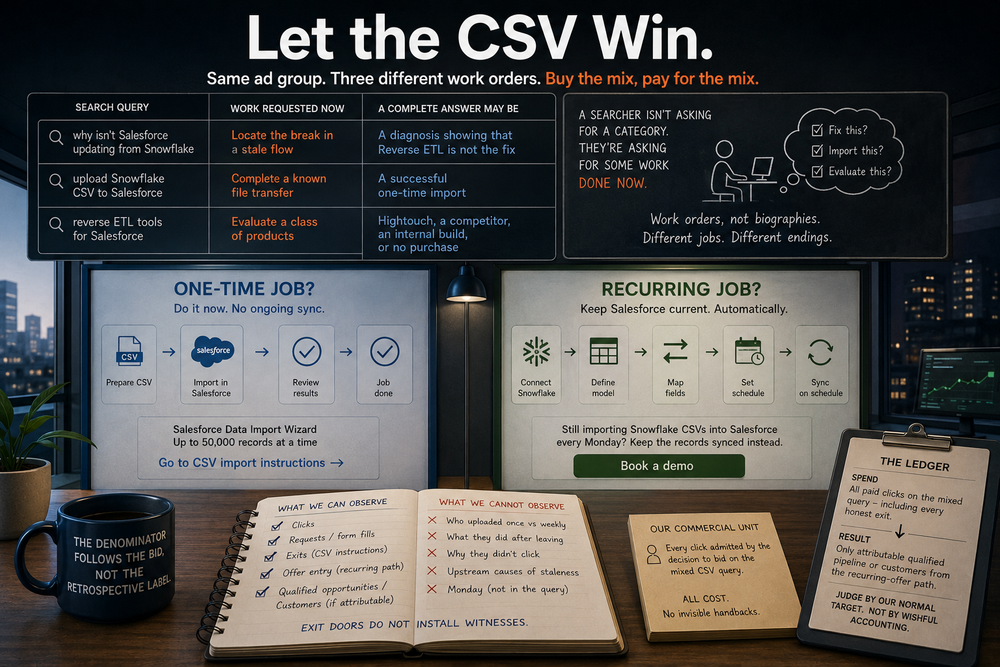
Put these three searches in the same ad-group planning sheet:
why isn't Salesforce updating from Snowflake
upload Snowflake CSV to Salesforce
reverse ETL tools for Salesforce
One product could honestly appear beside all three. That is precisely why buying
all three is dangerous.
The product is Hightouch. One part of Hightouch moves selected data from a
warehouse such as Snowflake into an operational system such as Salesforce, then
keeps moving it on a schedule. Its public connector page makes the machinery
unusually concrete: connect the source and destination, define the model, map
the fields, set the schedule, sync. The market has a category term for this
direction of travel—Reverse ETL—but a buyer does not need to know that term to
need the behavior.
This creates an irresistible growth story for a new B2B category. Category
queries look scarce. Sales calls keep repeating the pain. Symptom and workaround
phrases sit nearby. Buy that language, let the landing page translate it, and
meet the buyer before they know the noun.
There is only one troublesome detail: a searcher is not asking Google for the
largest true story behind their pain. They are asking it to do some work now.
Those three searches issue three different work orders. On the planning sheet,
the rows look adjacent. Read across, and their endings break apart:
| Search | Work requested now | A complete answer may be |
|---|---|---|
why isn't Salesforce updating from Snowflake |
Locate the break in a stale flow | A diagnosis showing that Reverse ETL is not the fix |
upload Snowflake CSV to Salesforce |
Complete a known file transfer | A successful one-time import |
reverse ETL tools for Salesforce |
Evaluate a class of products | Hightouch, a competitor, an internal build, or no purchase |
A diagnosis. A one-time import. A product decision. The first two searches are
not clumsy ways of asking the third. They may belong to people who need
different endings.
The table is deliberately about work, not biography. The CSV query tells us
what the person wants to do. It does not tell us whether this is their first
upload or their forty-seventh. That missing fact will become the whole
commercial problem.
The symptom is not the culprit
“Salesforce isn't updating” feels exquisitely close to a product that syncs data
into Salesforce. It is also a report of an observed state, not a diagnosis.
Hightouch once opened a public article with almost that exact internal ping:
“Why isn't Salesforce updated with the latest numbers?” The article then had to
discuss two different responsibilities: moving warehouse data outward and
knowing whether the data can be trusted. A Salesforce value might be stale
because no warehouse-to-CRM sync exists or because one failed. It might also be
stale in Snowflake already, delayed by an upstream job, broken by a schema
change, or otherwise unreliable before Hightouch would ever touch it. The
symptom does not identify the responsible
layer.
So a page meeting that search has to locate the break before it enlarges the
solution.
Is the expected record current in Snowflake? Is the modeled field present? Is
the corresponding Salesforce field stale? Is there an outbound sync? Did its
last run fail?
If the warehouse value is correct and Salesforce must remain current, the
product has earned its entrance. The page can show the actual substitution:
instead of waiting for a person or a custom job to push another copy, map the
fields once and run a continuing sync.
If the source value is late, say so. Hightouch loses. The visitor gains a
diagnosis.
That exit matters. Without it, symptom capture becomes an annexation strategy:
borrow the complaint, replace it with a diagram of the modern data stack, and
make Book a demo the only object in the room that looks like a door. The form
fill may be real. It is not evidence that the searcher wanted the category. It
may only prove that the page withheld the smaller answer.
An honest bridge must be able to lose the lead.
Monday changes the product
The workaround search is more specific:
upload Snowflake CSV to Salesforce
Source, destination, direction, file. Lovely. It may still describe a one-time
job.
Salesforce maintains a perfectly real tool for that job. Its Data Import
Wizard accepts CSV files and supports up to 50,000 records at a
time.
For somebody moving 600 records before lunch, “use the spreadsheet” is not a
primitive stage of enlightenment. It is a solution.
Hightouch offers a different
bargain. Its page
contrasts scheduled synchronization with manual CSV uploads and custom or
point-to-point pipelines. The replacement is not a cleverer one-time import. It
is an operation that keeps running.
That gives the page a useful fork:
Doing this once? Prepare the CSV, test a small file, map the fields in
Salesforce, run the import, and review the result.
Doing this every Monday—or trying to keep Salesforce current without a
person? Connect Snowflake, define the model, map the fields, and schedule the
sync.
These are not two levels of customer sophistication. They are two jobs. The
smaller one should remain usable, not survive as a gray “other options” link
whose chief function is making the blue demo button look inevitable.
The recurring job should be equally literal. “Unlock your data” does not tell
the operator what disappears. This does:
Still importing Snowflake CSVs into Salesforce every Monday? Keep the records
synced instead.
“Every Monday” does more work than “modernize your data stack.” It names the
ritual the product will remove. The one-time importer can ignore the ad. The
person preparing upload number 47, checking the mapping, and enjoying the
special suspense created by a renamed column can feel personally observed.
One upload is a task. A calendar reminder is the same task applying for a
management position.
Now notice the sleight of hand: Monday came from us.
It was not in upload Snowflake CSV to Salesforce. Neither was upload number
47. The same query could be typed by someone doing this once, someone doing it
weekly, or an assistant discovering that the person who normally does it has
gone camping with the permissions.
The ad can propose recurrence. The page can ask about it. Neither can recover a
history the query never supplied.
The exit door has no turnstile
The exit door is the Salesforce-instructions link. Suppose the one-time importer
clicks it and leaves. The dashboard records a page view, a link click, and then
silence. It does not record a completed import. The visitor may have mapped all
600 records, discovered they lacked permission, opened the instructions in tab
19, or gone to lunch with the serene confidence of someone who has moved the
problem to after lunch.
A click on instructions is evidence that somebody clicked instructions.
Calling it “manual job completed” does not make the job more complete. It makes
the event name more ambitious.
The diagnostic exit has the same limit. Someone who reads “check Snowflake
first” and disappears may have found the upstream failure or found the page
irrelevant. In either case, the dashboard can mark the path. It cannot witness
the ending: an exit door does not install a witness outside it.
Now follow the other path. A visitor may click Keep this synced, request a
demo, or begin whatever product action the page actually offers. Record that
action as recurring-offer entry. The event marks only that the session entered
the recurring-sync branch—not whether the visitor has uploaded before, why they
acted, or whether they will become a customer.
The later record is different. The business's existing attribution may join
that branch event to a qualified opportunity or customer. If it cannot make the
join, the outcome does not belong to the product-path result. If the join is
uncertain, so is the outcome assigned to that path. Even a clean join does not
establish that the ad caused the customer, recover the customer's upload
history, or turn “CSV searchers” into a recurring-demand population.
The evidence gets stronger downstream. It does not travel backward and add
Monday to the search.
That is what the honest fork earns: evidence less contaminated by a withheld
answer, not knowledge of what happened after the visitor left.
The denominator follows the bid
This gives the paid-search operator a less glamorous, more useful commercial
unit.
It is not “people who secretly upload every Monday.” That population cannot be
bought from a query that never mentions recurrence.
The unit is every click admitted by the decision to bid on the mixed CSV
query.
If you buy upload Snowflake CSV to Salesforce with an ad for recurring sync,
the bill includes the first-time importer moving 600 records before lunch, the
weekly operator, the person who clicks the product path, and the person who
leaves through the useful CSV instructions. You cannot wait until the
product-path visitors identify themselves, draw a neat circle around them, and
pretend that circle was the traffic you purchased.
The paid-click bill arrives with every admitted click already printed on it.
Later outcomes can add credit; they cannot tear off the inconvenient line
items.
The record can get richer. The denominator cannot get smaller.
After the normal buying cycle, put both sides of the commercial test on the
same ledger:
- Spend: every paid click on
upload Snowflake CSV to Salesforce, including
every honest exit through the CSV instructions. - Result: only qualified pipeline or customer outcomes the business's
existing attribution can join to a recordedrecurring-offer entry. An
unjoinable outcome stays off this side; an uncertain join remains uncertain.
If qualified pipeline is the furthest established result, put pipeline—not
profit—on the result side. The conclusion is then about pipeline efficiency,
not profit. Judge the comparison by the business's normal target for that
result; do not invent friendlier rules for this query.
Do not count invisible handbacks as wins. Count their cost.
If the customer result supports the full spend at that target, the conclusion
is narrow: this business can afford to buy this mixed workaround traffic for
this offer. It is not “the query expresses recurrence,” and it is not “the
category is arriving.” If the available result does not support the whole bill,
let the query go. Do not hide the CSV instructions, recast the exits as engaged
prospects, or move their cost into a more spiritually compatible spreadsheet.
The same accounting applies to the symptom query. Its causes remain mixed, so
its entire click bill belongs to the decision that invited them—even when a
customer emerges.
The denominator follows the bid, not the retrospective label.
The noun can be late. Monday cannot be invented.
Now compare two searches:
keep Snowflake product usage data current in Salesforce automatically
what is reverse ETL
The first contains no category term. It names the source, destination, data,
desired state, and operating cadence. Most importantly, current automatically
has already rejected a one-time CSV. Recurrence is not a story added by the
landing page; it is present in the work order.
The second contains the approved noun and asks for a definition. The searcher
may be a buyer, a student, an investor, or somebody trying to understand the
sentence that just sailed past them in a meeting. A useful explanation can
introduce products. The noun has not made a demo the requested ending.
This reverses the familiar awareness ladder. Nounless language can be more
commercially formed than pristine category language. What matters is not how
sophisticated the vocabulary sounds. It is whether the searcher has described
the change they need.
A market may begin agreeing on the operating bargain before it agrees on the
name. Among the search terms an account can see, the meaningful language change
is not a mysterious promotion of all CSV queries into “recurring.” It is the
appearance and repetition of explicit conditions the one-time completion cannot
satisfy: keep current, automatically, scheduled, every Monday, without
CSV.
Those phrases can own a recurrence claim because recurrence is in them. The
mixed CSV query cannot. Leave it mixed even if it sometimes produces the same
customer.
This leaves two honest ledgers. Explicit recurring language tests an expressed
recurring job against every click that language admitted. Mixed workaround
language tests whether buying the ambiguity acquires customers against every
click that ambiguity admitted. Only the first can support a claim that the
market's search language is converging on the new operating bargain. The second
may still be a viable acquisition tactic; it cannot also prove category
formation.
Symptom, workaround, and category searches are not three stages of one funnel.
The person fixing an upstream freshness failure, the person making a one-off
import, and the person comparing Reverse ETL products may be three different
people who never exchange costumes. Putting their three work orders in one ad
group does not make them one job.
Neither low category volume nor abundant workaround traffic settles the market
question. An aggressive landing page can only make the dashboard look certain
sooner.
Let the CSV win. Let the product win when somebody actually buys it. Let the
mixed query remain mixed.
Paid search can translate a missing noun. It cannot invent a missing Monday.